

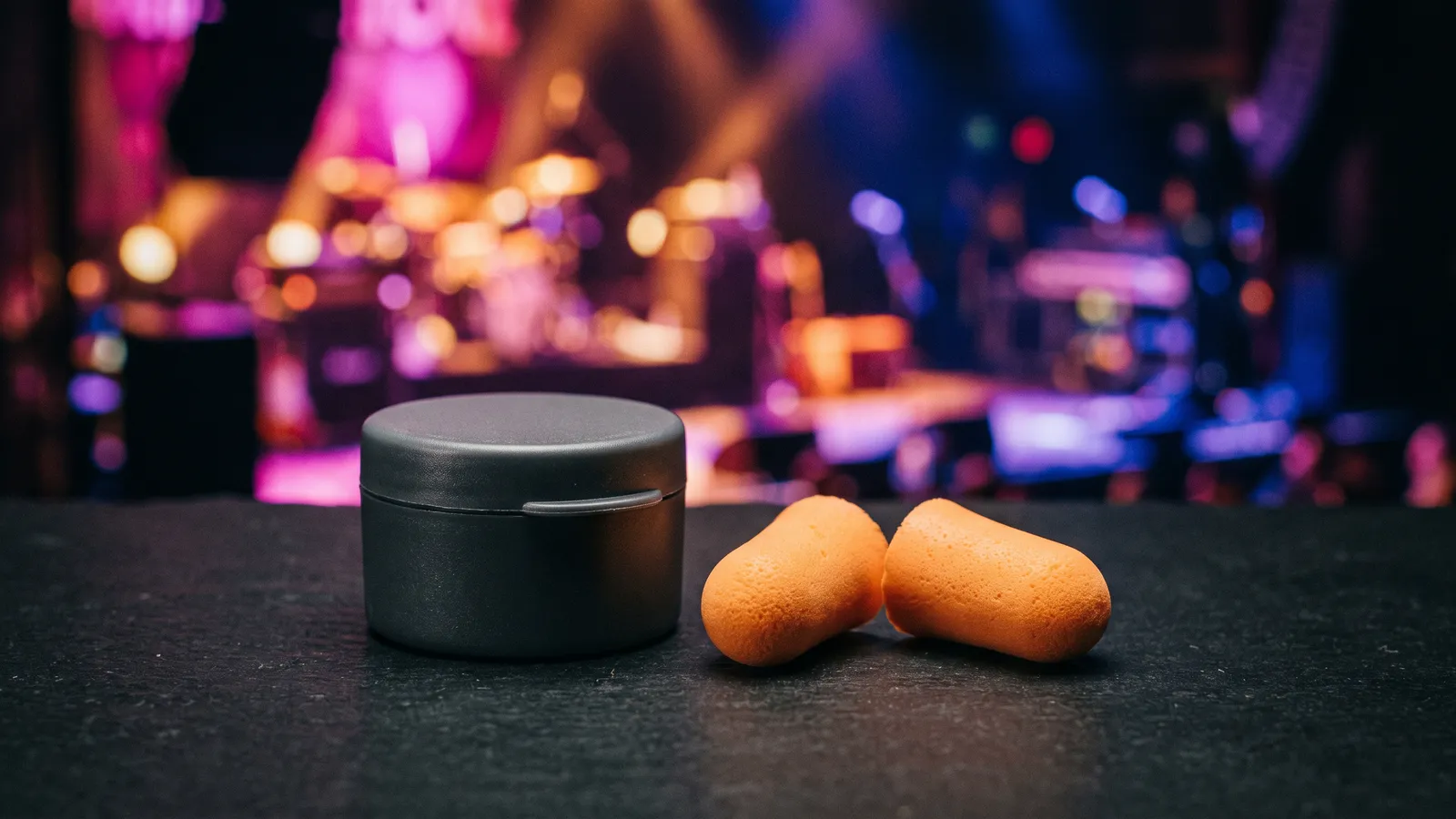
A pop or rock concert is loud enough to hurt your hearing in minutes, not hours. Australia's National Acoustic Laboratories (through its Know Your Noise site) puts a typical pop/rock gig at 103 dB and gives it a safe listening time of 7.5 minutes. A headline set runs well past that.
The good news is that the fix is simple. Put earplugs in before the first band, don't plant yourself next to the speaker stacks, and give your ears a break now and then. Do those three things and you can stay for the whole night without paying for it later.
Everything below comes from health bodies in Australia, New Zealand, the US and the UK, checked on 3 October 2026. This is general information, not medical advice. If you're worried about your hearing, see a doctor or book a hearing check (there are free options in both countries, covered below).
Key things to know
- Know Your Noise puts a pop or rock concert at 103 dB, with a safe listening time of just 7.5 minutes without protection.
- WHO's weekly allowance at 100 dB is 20 minutes. Earplugs, distance from the speakers and breaks all buy you more time.
- Music (high-fidelity) earplugs turn the volume down without muffling the sound. Cotton wool doesn't protect your ears.
- Muffled hearing after a gig usually clears in 16-48 hours, but it can still leave lasting damage. Sudden hearing loss means ED.
- Free hearing checks: Hearing Australia for adults 18+ with no referral; Your Way | Kia Roha in NZ for citizens and residents 16+.
On this page
How loud is a concert?
Louder than most people guess. The figures:
- Know Your Noise (Australia): a pop/rock concert is 103 dB, with a safe duration of 7.5 minutes.
- NIDCD (US National Institutes of Health): music through headphones, sporting events and concerts range from 94 to 110 dBA.
- Hearing Australia: concerts "are often really loud and usually last for a couple of hours, they nearly always push you over your daily noise dose." It also says a 3-hour nightclub visit equals about 6 daily sound doses.
For comparison, Know Your Noise says sounds below 75 dB are unlikely to cause hearing loss even after long exposure, and that repeated or long exposure at 85 dB and above causes permanent damage. The NIDCD says sounds at or below 70 dBA are unlikely to cause hearing loss, and sets its risk line at 85 dBA. WHO puts the safe level at below 80 dB.
The CDC sums up why time matters: "The louder the sound, the shorter the amount of time it takes for hearing loss to occur."
WHO's weekly safe listening limits
The World Health Organization gives a weekly allowance for each volume. Every 5 dB step up cuts your safe time by a big chunk:
| Sound level | Safe listening time per week (WHO) |
|---|---|
| 80 dB | 40 hours |
| 85 dB | 12 hours 30 minutes |
| 90 dB | 4 hours |
| 95 dB | 1 hour 15 minutes |
| 100 dB | 20 minutes |
| 105 dB | 8 minutes |
| 110 dB | 2.5 minutes |
| 120 dB | 12 seconds |
Put a 103 dB gig against that table and you can see the problem. Without protection, one show uses up your week's allowance before the support act finishes.
How can you tell it's too loud?
Know Your Noise has a simple rule: if you have to raise your voice to be heard, it's too loud. At most gigs, that's the whole room.
If you want a number, Hearing Australia lists a few sound-level apps:
- NoiSee, which shows how long you can stay before you reach your daily sound dose
- NIOSH Sound Level Meter
- SPLnFFT
- Decibel X
- The Noise app on Apple Watch, which alerts you when the volume reaches a level that can affect your hearing
Know Your Noise also has a free online Noise Risk Calculator, if you want to add up a big weekend of shows.
Which earplugs are best for concerts?
Any earplug worn properly beats none. WHO's advice is simply to "wear earplugs regularly and properly". Know Your Noise suggests quality earplugs designed for music events. Here's how the main types compare, based on Hearing Australia and the UK hearing charity RNID.
| Type | What it is | Good to know |
|---|---|---|
| Foam (disposable) | Soft foam you roll and insert | Basic protection. Has to be fitted properly to seal the ear canal |
| Reusable pre-moulded | Foam, soft plastic or rubber, washable | No rolling needed, but RNID says they may not fit as snugly as custom-made plugs |
| Music (high-fidelity) | Plugs with acoustic filters | Built to turn the volume down without wrecking the sound quality |
| Custom-moulded | Made to fit your ears | Cost more, but RNID says they fit better, block noise more effectively and can last several years |
| Earmuffs / ear defenders | Cups over the ears, like big headphones | Hearing Australia names kids' earmuffs for gigs (see below) |
Foam earplugs: fine, if you fit them right
RNID describes the fitting like this: "Most disposable earplugs need to be rolled between your fingers, inserted into the ear and held in place until they expand to fill and seal the ear canal." If a foam plug is just sitting in the entrance to your ear, it isn't doing much. Roll it thin, push it in, and hold it while it expands.
Hearing Australia lists foam and silicon earplugs as giving basic protection. They're easy to keep in a bag or pocket, which matters more than anything else, because the earplugs at home don't help.
Music earplugs: the ones gig regulars use
Hearing Australia describes high-fidelity music earplugs as "designed to lower the volume of the music without impacting on the sound quality". RNID says they "have acoustic filters to reduce noise at specific pitches, so loud and live music is heard at normal but safe levels". Its music page puts it plainly: the reusable kind made for clubbers and musicians "don't muffle sound, just make it a bit quieter and a lot safer."
If you go to a lot of shows, these are worth having. You'll actually keep them in, because the band still sounds like the band.
Custom-moulded earplugs
These are shaped to your ears, often with a swappable filter like the pair in the photo above. RNID says that "with the better fit they should attenuate noise more effectively and be more comfortable", and they "may last for several years". They cost more than off-the-shelf plugs.
Don't use cotton wool or tissues
RNID says "ordinary cotton wool isn't recommended for this purpose", and Know Your Noise says cotton gives minimal protection. If you've forgotten your earplugs, ask staff whether the venue has any. Not every venue does, so check with the venue before the show rather than counting on it.
A hearing kit worth packing
Earplugs only work if they're with you. A small kit takes up almost no room, which matters at venues with tight bag limits (check the venue's bag policy first).
- High-fidelity music earplugs. Hearing Australia recommends these for concerts.
- A hard carry case or keyring pouch. It keeps them clean and stops them getting lost at the bottom of a bag.
- A spare pair of disposable foam earplugs. They're cheap insurance if you lose or forget your main pair, or a mate does.
- Kids' earmuffs, sized for their age, if you're taking young children. Hearing Australia says there are fits from babies up to older kids.
- A sound-level app on your phone or watch, if you want to see the numbers for yourself.
Where to stand: distance from the speakers
This one costs nothing. WHO says to "stay away from loudspeakers/amplifiers" at clubs and concerts, because sound gets less intense the further you are from the source. RNID puts it bluntly: "the closer you are, the greater the risk of hearing damage." Hearing Australia's advice is to "stand a little further away from the speakers at your next live music gig."
In practice:
- Don't pick the spot right in front of the PA stacks, even if it's a great view.
- If your ears start to feel full or uncomfortable, move back. That's your cue.
Take a break every hour
WHO recommends you "rest your ears in a quiet space for 10 minutes after every hour". The CDC says the same thing in three words each: walk away from loud noise, take breaks from noise, use hearing protection. RNID points out that chill-out zones in clubs are perfect for this.
Between sets is the obvious time: head to the foyer, the bar or outside while the stage gets changed over.
What does a hearing-safe venue look like?
In March 2022 WHO published a "Global standard for safe listening venues and events". It's a recommendation, not a law, and none of the sources we checked show it's a legal requirement in Australia, New Zealand or the US. It's still a good checklist for what a well-run gig should offer. The six features are:
- A maximum average sound level of 100 decibels
- Live monitoring and recording of sound levels, using calibrated equipment, by designated staff
- Venue acoustics and sound systems set up for both good sound and safe listening
- Hearing protection available to audiences, with instructions on how to use it
- Quiet zones where people can rest their ears
- Training and information for staff
WHO notes that nightclubs, bars, concerts and sporting events often don't have these provisions. If it matters to you, check with the venue before the show whether it hands out earplugs or has a quieter area you can step into.
Taking kids to a concert
Hearing Australia recommends protective equipment for young children at music concerts and fireworks, and says research suggests noise damage at an early age leads to relatively poorer hearing later in life.
- Earmuffs (ear defenders) are the usual choice for kids. Hearing Australia says there are children's earmuffs that fit from around 2 years of age, and others made for babies from 0-18 months.
- Teach them about distance. Hearing Australia suggests showing children "how the sound gets softer when they move away from the speakers", and letting them pick a spot where their ears feel comfortable.
- Kids get ringing ears too. Hearing Australia says children can have tinnitus, with much the same symptoms as adults. If your child mentions ringing or buzzing, get their hearing checked.
Ringing ears after a concert: how long does it last?
You walk out, your ears feel full, voices sound muffled and there's a ringing or buzzing. Hearing Australia lists exactly these as signs you've had too much noise.
How long it lasts: the NIDCD and Know Your Noise both say temporary hearing loss usually goes away within 16 to 48 hours. But Know Your Noise warns it may still leave residual damage, so "it went away" doesn't mean "no harm done". Do it often enough and the damage adds up.
The ringing (tinnitus): Hearing Australia says that "in many cases, tinnitus is only temporary and can be brought on after a concert". For some people it becomes constant. The NIDCD says noise-induced tinnitus can last a lifetime, and Hearing Australia says there's no known cure, though it can be managed.
Is the damage permanent? It can be. Healthdirect says hearing loss from loud noise "is usually permanent", and the CDC says there's no medical or surgical treatment for noise-induced hearing loss. That's why protection before the show matters more than anything you do after it.
When to see a doctor
- Sudden hearing loss: Healthdirect says this needs assessment at an emergency department. Don't wait it out.
- Hearing loss after loud noise: Healthdirect says to see a doctor.
- Ringing that sticks around: Healthdirect says "See your doctor if you have symptoms of tinnitus or hearing loss."
WHO's warning signs of hearing damage are worth knowing too: ringing that doesn't go away, trouble hearing high-pitched sounds like birds, doorbells, phones or alarms, trouble understanding speech (especially on the phone), and struggling to follow conversations in noisy places.
Free hearing checks in Australia and New Zealand
If you go to a lot of gigs, a hearing check gives you a baseline.
Australia: Hearing Australia runs free 15-minute adult hearing checks. They're free for adults aged 18 and over, with no referral needed. You book by postcode or suburb and get your results on the spot. Hearing Australia also has a free online hearing check on its website, and Know Your Noise has an online hearing test.
New Zealand: Your Way | Kia Roha (formerly Life Unlimited) offers free hearing tests for people aged 16 and over who are New Zealand citizens or permanent residents. No referral is needed, and the service is fully funded by the New Zealand Government. It's independent and doesn't sell or fit hearing aids. You can book on its website or call 0800 008 011.
United States: the CDC's advice is to contact your doctor if you're concerned about your hearing.
Quick answers
Should I wear earplugs to a concert?
Yes. Healthdirect's advice is to use earmuffs or earplugs "especially in noisy workplaces or at concerts", and at 103 dB a gig goes past the safe limit in minutes.
Are foam earplugs good for concerts?
Hearing Australia counts foam plugs as basic protection, and they only work if you fit them properly: roll, insert, hold until they expand (RNID). If you want the music to sound closer to normal, music earplugs with filters are designed to lower the volume while keeping the sound quality.
Can my ears still ring if I wore earplugs?
If they do, take it as the same warning: Hearing Australia lists ringing as a sign you've had too much noise. Check the plugs are sealing properly, stand further from the speakers and take breaks next time. If the ringing hangs around, Healthdirect says to see your doctor.
Will my ears recover from a concert?
Muffled hearing usually clears within 16-48 hours, according to the NIDCD and Know Your Noise. It can still leave some lasting damage, and repeated exposure adds up. Sudden hearing loss needs an emergency department.
How loud is a concert in decibels?
Somewhere between 94 and 110 dBA, according to the NIDCD. Know Your Noise uses 103 dB for a pop or rock concert.
Sources
24 sources used for this guide
- WHO: Deafness and hearing loss - safe listening (Q&A)
- WHO: Deafness and hearing loss fact sheet
- WHO: Global standard for safe listening venues and events
- WHO: News release on the safe listening venues standard (2 March 2022)
- WHO: Make Listening Safe
- Know Your Noise (National Acoustic Laboratories): Home
- Know Your Noise: Hearing health
- Hearing Australia: Home (online hearing check)
- Hearing Australia: How can I stop noise from damaging my hearing?
- Hearing Australia: How can I tell when it's too loud?
- Hearing Australia: Is my hearing at risk?
- Hearing Australia: What can I do to protect my child's hearing?
- Hearing Australia: Tinnitus - what is it and how to treat it
- Hearing Australia: Tinnitus in children
- Hearing Australia: Free 15-minute adult hearing checks
- Healthdirect: Hearing loss
- Healthdirect: Tinnitus
- Your Way | Kia Roha (formerly Life Unlimited): Home
- Your Way | Kia Roha: Hearing
- NIDCD (US National Institutes of Health): Noise-induced hearing loss
- CDC: Causes of hearing loss
- CDC: Preventing hearing loss
- RNID: Types of hearing protection
- RNID: Listen to music safely