

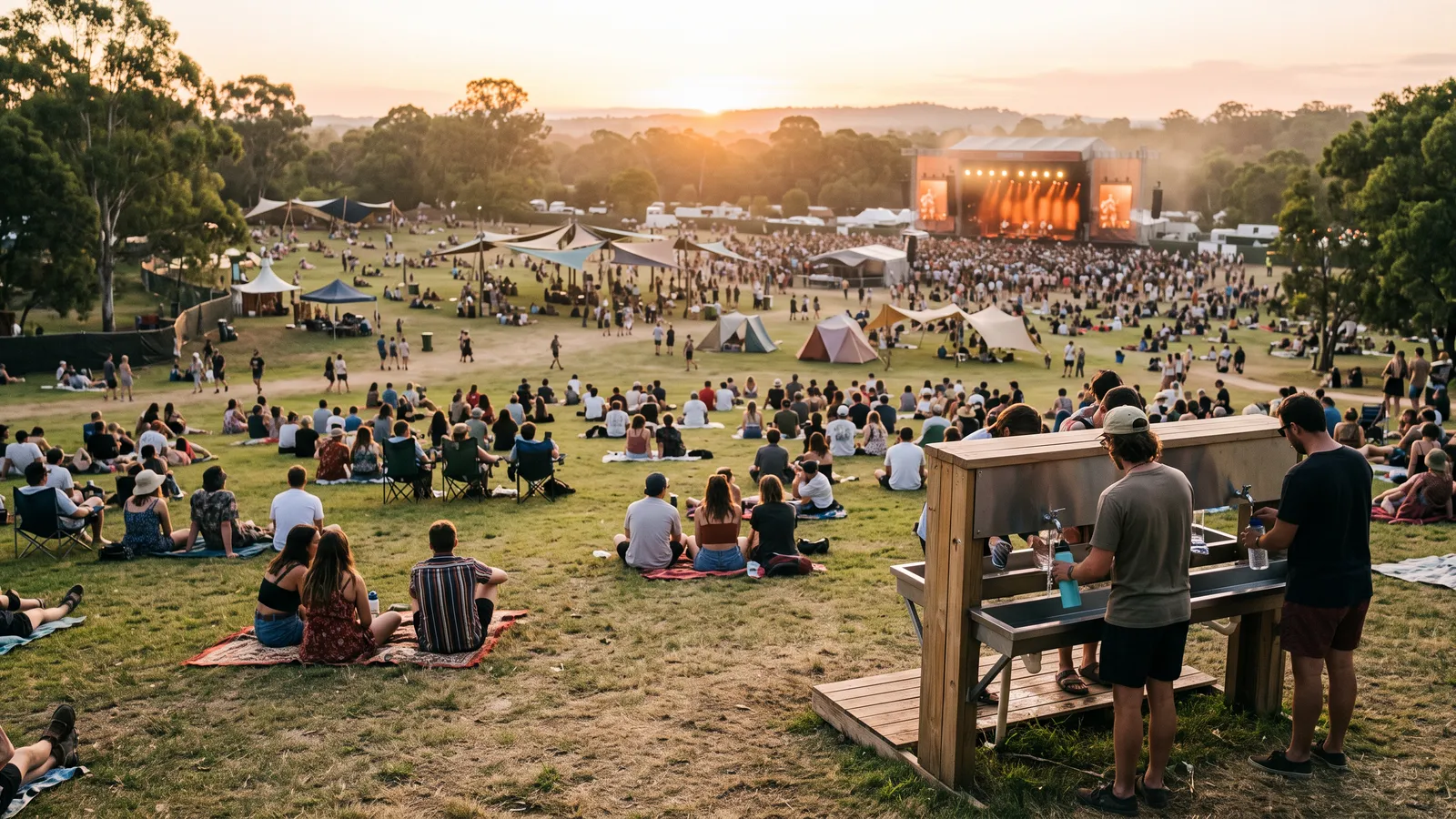
Most gigs go off without a hitch. When something does go wrong, it's usually a crowd that gets too tight, a hot day without enough water, a tampered drink, or a mate who's unwell and doesn't want to make a fuss. You don't need to be on edge all night. A few habits, mostly sorted before you leave home, cover most of it.
Crowd safety is mainly the organiser's job. Crowd researchers say most major crowd disasters could have been prevented by simple crowd management, so the point of this guide isn't to make it your problem. It's to help you spot trouble early and know what to do.
Everything here comes from health departments, police, emergency services and venue conditions of entry, checked in October 2026. It's general information, not medical advice, and we're not connected to anyone mentioned.
Key things to know
- In an emergency call 000 in Australia, 111 in New Zealand or 911 in the US. Emergency+ helps Australian callers give their location.
- If a crowd surges, crowd researcher Keith Still's advice is to go with it and move sideways. Try to stay upright and away from walls.
- At festivals NSW Health says sip, don't gulp: roughly 500ml of water an hour while dancing. Too much water can be dangerous too.
- Most spiked drinks are spiked with alcohol. Feel drunker than you should? Tell a mate or staff straight away and don't leave alone.
- NSW Health's festival advice: you won't get into trouble for getting help. Find the medical tent and peer support crews early.
On this page
Quick answers
| Emergency number | 000 (Australia), 111 (NZ), 911 (US) |
| Free health advice (Australia) | healthdirect on 1800 022 222 |
| Crowd surge | Go with it and move sideways; try to stay upright |
| Water at a festival | Sip, don't gulp: about 500ml an hour dancing |
| Drink spiking | Usually alcohol. Tell a friend or staff straight away; don't leave alone |
What should I do before I go?
Read the venue's conditions of entry. A lot of the rules that look like fussiness are really safety rules, and they differ from venue to venue. As of October 2026, for example:
- Auckland's Spark Arena says "All bottles of any kind (cans, glass, plastic) are not permitted unless specifically allowed", bans crowd surfing and climbing on barricades, and says anyone intoxicated or using drugs will be removed. Under-15s can't be in standing areas without an adult (18+).
- Melbourne's Marvel Stadium bans glass and cans, lets you bring an umbrella but not open it, and doesn't issue pass outs except in exceptional circumstances. If you're removed, it's an offence to re-enter or try to within 24 hours.
- Melbourne Park has separate conditions for each of its venues, so check the one you're actually going to, not just the precinct.
Spark Arena and Marvel Stadium can both search bags. Rules on empty water bottles vary, so check the event page.
Check the weather and UV. For outdoor shows, SunSmart says to cover up once the UV index hits 3, and its SunSmart Global UV app shows the sun-protection times for the day.
Sort out your phone. Charge it, and if you're in Australia, install Emergency+. It's a free app from the emergency services and government partners that uses your phone's GPS to help you tell a 000 operator exactly where you are. In a stadium car park or a big festival site, that matters.
Agree on a plan with your mates. NSW Health's festival advice is to set up emergency signals and a meeting point before you go in. Pick somewhere easy to find, not "near the stage".
Pack earplugs. Healthdirect specifically says to use earplugs or earmuffs at concerts, and treats ringing or buzzing in your ears afterwards as a warning sign.
What should I pack for a safe night?
Keep it small, since most venues cap bag size, and check the venue's bag policy before you leave. These item types cover the problems this guide is about.
- A slim power bank and a short charging cable, if the venue allows power banks. A charged phone is how you call for help, find your mates and show your ticket.
- High-fidelity concert earplugs in a small case.
- Sun protection for day shows. Broad-spectrum SPF50 or 50+ sunscreen in a squeeze tube (aerosols are banned at many venues), a hat and sunglasses.
- A lightweight poncho for rain or a cold night.
- Water, within the venue's rules. Many venues allow one sealed bottle and some allow none. Where there are free refill stations, use them.
- Comfortable closed shoes, so you can stay on your feet and move easily if the crowd tightens.
- A zip pouch or phone case with a card slot for your card, ID and keys, so nothing is loose in your pockets.
How do I stay safe in a big crowd?
Most crowd advice comes down to noticing early and leaving early. The crowd-science figures quoted on Wikipedia's crowd-crush page give a useful sense of what tight feels like:
| People per square metre | What it's like |
|---|---|
| 1 to 2 | You can move freely |
| 3 to 4 | Low risk |
| About 5 | Moving becomes difficult |
| 6 to 7 | People are pressed together and the crowd moves like a fluid |
| 8 to 10 | Risk of crushing and asphyxiation |
You don't need to count heads. If you're pressed in on all sides and being moved rather than moving, work your way out sideways towards the edge while you still can.
A few habits that help:
- Know your exits. The US government's Ready.gov puts it simply: "Have an exit plan." Find the nearest ones when you arrive.
- Pick your spot with leaving in mind. Nearer the edges or back, there's space to get out.
- Listen to the crowd. Crowd researcher Keith Still advises staying aware of your surroundings and the noise of the crowd.
- Tell security if something looks wrong. If you see someone go down or an area getting dangerously tight, tell the nearest staff member.
What do I do if the crowd surges?
Keith Still's advice, as quoted on Wikipedia, is to "wait for the surge to come, go with it, and move sideways. Keep moving with it and sideways." Each time it eases, take a step or two sideways towards the edge.
The same page advises trying to stay upright, and keeping away from walls, barriers and other things you could be pinned against where you can.
It also corrects a myth: crushes aren't caused by panicking stampedes. As one researcher quoted there puts it, "people don't die because they panic. They panic because they are dying." The most common cause of death is asphyxiation, from people falling on each other or being squeezed so hard they can't breathe. At the Astroworld Festival in Houston in November 2021, the medical examiner found all 10 people who died had suffered compressive asphyxiation. Moving away early isn't overreacting.
How do I avoid heat exhaustion at an outdoor gig?
Healthdirect says to drink plenty of water when it's hot, even if you're not thirsty, and to avoid direct sun in the hottest part of the day (it names 11am to 5pm). At a day festival, use the shade and chill-out areas.
How much water should I drink?
NSW Health's festival advice is "sip, don't gulp": roughly 500ml an hour if you're dancing. Drinking far too much water can dangerously throw out your body's electrolyte levels. The same page notes that MDMA interrupts your body's cooling mechanism, so heat is a bigger risk for anyone who's taken it.
Healthdirect also points out that drinking too much alcohol dehydrates you. Signs of dehydration it lists include thirst, a dry mouth, dizziness, a headache, dark urine and peeing less.
Heat exhaustion or heatstroke: what's the difference?
Healthdirect draws the line like this:
- Heat exhaustion: body temperature normal or slightly raised, skin cool, pale and clammy, and the person is still sweating, often heavily. Move somewhere cool, drink cool water, a sports drink or an oral rehydration solution, and avoid caffeine and alcohol. Call 000 if it gets worse or they feel faint.
- Heatstroke: body temperature above 40°C, skin red and hot or dry, and they may have stopped sweating. They may be confused, have slurred speech or behave aggressively, have a seizure or lose consciousness. This is an emergency: call 000 straight away. While you wait, healthdirect says to get them into shade, remove extra clothing, sponge them with cool water and apply cold packs, give sips of cool fluid if they're conscious, and put them on their side if they're unconscious.
At an event, send someone to the medical tent or security while you call.
NSW Health notes that older people, people with medical conditions, babies and young children, and pregnant women are more at risk in the heat.
What if I feel faint?
Standing for a long time, heat and dehydration are all common causes of fainting, according to healthdirect. Warning signs include sweating, weakness, dizziness, blurred vision, nausea and going pale. If you feel it coming on, healthdirect says to lie down with your legs raised higher than your head for about 10 minutes, drink water, get some fresh air and change position slowly. In a packed crowd, tell your mates and get out to the side or to first aid early.
Call 000 if someone who fainted has chest pain, an irregular heartbeat or shortness of breath, was unconscious for more than a few minutes, fainted while sitting or lying down, is over 60, or has a heart condition.
How can I tell if my drink has been spiked?
Drink spiking means putting alcohol or drugs into someone's drink without them knowing. It's illegal in every Australian state and territory. Better Health Channel says you may not be able to tell by smell or taste.
The Alcohol and Drug Foundation says most spiked drinks are spiked with extra alcohol, and drugs like GHB and Rohypnol are "actually quite rare". So the main sign is feeling much drunker than you should for what you've had. Other signs listed by Better Health Channel, the ADF and Victoria Police include dizziness or fainting, drowsiness, confusion, memory loss, slurred speech, nausea or vomiting, and trouble breathing.
What should I do if I think I've been spiked?
Victoria Police's advice:
- Tell a trusted friend or a staff member straight away.
- Don't try to leave on your own.
- Call 000 if someone is unconscious or vomiting. In the police's words: "Do not wait and hope it will pass."
The ADF says medical tests can pick up drugs for up to about 24 hours, so get help and report it early if you want it looked into. For support, Victoria Police lists Crime Stoppers on 1800 333 000 (anonymous, 24/7) and the Sexual Assault Crisis Line on 1800 806 292, and the ADF lists 1800RESPECT on 1800 737 732.
Victoria Police's prevention tips: don't accept drinks from strangers, don't leave yours unattended, watch it being poured, and stay with people you trust. But Better Health Channel is clear on the bigger point. "It is never someone's fault if their drink was spiked."
How do I look after my mates?
The buddy system does most of the work. Check in through the night, and don't let anyone wander off alone when they're not feeling right.
NSW Health's Stay OK page has some of the most practical advice around for festivals:
- Find the medical tent and peer support crews when you arrive, before you need them. It names DanceWize NSW, Red Frogs and ACON Rovers.
- "Don't risk leaving the festival if you feel unwell." Get help on site instead.
- "You won't get into trouble for getting help."
- If someone's using drugs, the page says to make sure someone is with them or knows. It also notes opioids are increasingly turning up in other drugs, suggests carrying naloxone nasal spray, and lists overdose signs including pinpoint pupils, slow breathing and unconsciousness.
DanceWize, run by Harm Reduction Victoria, has worked at music events since 1999 with volunteers trained in first aid and mental health first aid. Red Frogs volunteers also provide peer support at music events.
Drug checking exists in some places. As of October 2026, NSW Health and NUAA run a free, confidential drug checking service at up to 15 music festivals a year. In New Zealand, KnowYourStuffNZ has operated legally with public funding since 2020, with free, confidential checking at events and regular clinics in Auckland, Waikato, Wellington, Christchurch and Dunedin.
What do I do in an emergency?
Call 000 in Australia, 111 in New Zealand or 911 in the US. NZ Police says: "If it's happening now, or someone's in danger, call 111." For anything that isn't urgent, such as reporting lost property, use 105.
Then tell the nearest security guard or staff member, or send someone to the medical tent. In Australia, Emergency+ can show your GPS location so you can read it out to the operator.
Healthdirect's first aid basics follow DRSABCD: Danger, Response, Send for help, Airway, Breathing, CPR and Defibrillation. If someone is unresponsive but breathing, healthdirect says to put them in the recovery position. Ready.gov also suggests learning first aid.
How do I get home safely after a late gig?
Decide how you're getting home before you go, and tell someone your plans. Victoria Police suggests designated drivers and supervised taxi ranks, and recommends staying with friends you trust.
In NSW, Transport for NSW runs secure taxi ranks with security guards on duty, mainly on Friday and Saturday nights. They're in the Sydney CBD, Kings Cross, Parramatta, Manly, Coogee and Cronulla, plus regional spots including Newcastle, Wollongong and Byron Bay. Most CBD ranks run from 10pm to 5am, though hours vary by rank. Drivers may ask you to pay upfront, and the rank supervisors can help estimate the fare.
For city-by-city detail on last trains, late buses and taxi ranks, see our Melbourne concerts guide, Brisbane concerts guide and Wellington concerts guide.
Common questions
Will I get in trouble if I go to the medical tent after taking something? NSW Health's festival page says "You won't get into trouble for getting help." The same page says not to risk leaving the festival if you feel unwell.
Can I bring water into a concert? It depends on the venue. Spark Arena, for example, doesn't allow bottles of any kind unless they're specifically allowed for that event. Check the event page or the venue's conditions of entry before you go.
Does "Ask for Angela" work in Australia or New Zealand? Ask for Angela is a UK scheme, where you ask staff for "Angela" at a participating venue and they help you discreetly. Don't count on it here unless a venue says it takes part. Going straight to staff or security works anywhere.
A quick checklist
- I've read the venue's conditions of entry for this event.
- My phone is charged, and Emergency+ is installed (Australia).
- We've agreed a meeting point and how we'll find each other.
- I know 000 (Australia), 111 (NZ) or 911 (US).
- I've got sun protection and earplugs.
- I'll find the exits, the medical tent and the peer support crew when I arrive.
- I know how I'm getting home, and someone else knows too.
Sources
25 sources used for this guide
- Wikipedia: Crowd collapses and crushes
- Wikipedia: Astroworld Festival crowd crush
- Ready.gov: Public spaces
- Spark Arena: Conditions of entry
- Marvel Stadium: Conditions of entry
- Melbourne & Olympic Parks: Conditions of entry
- healthdirect: Heatstroke
- NSW Health: Beat the heat
- healthdirect: Dehydration
- healthdirect: Fainting
- SunSmart
- Better Health Channel: Drink spiking
- Alcohol and Drug Foundation: Drink spiking
- Victoria Police: Drink spiking
- NSW Health Your Room: Stay OK at music festivals
- NSW Health Your Room: Drug checking
- KnowYourStuffNZ
- Harm Reduction Victoria: DanceWize
- Red Frogs Australia
- Ask for Angela
- Emergency+
- healthdirect: First aid
- NZ Police: Use 105
- Transport for NSW: Secure taxi ranks
- healthdirect: Hearing loss prevention